2020 Parenting Survey Results:
Spankings are still an overwhelmingly accepted disciplinary tool for the large majority of American parents, according to a recent survey in 2020
Report also finds that millennials are even more likely than older generations to approve of spanking.
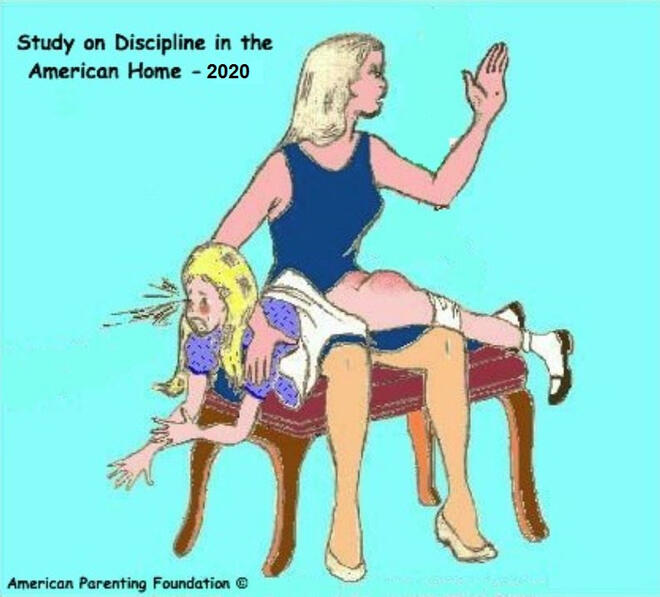
14th December 2020. Report by Jessica Ruth:
Are you sitting comfortably?...Ok great, because recent surveys across the U.S. have highlighted that most of those butts we're sitting on have probably been the recipients of a good few spankings growing up. Furthermore, the prevalence of spanking in US families seems to continue to be very common in modern households, despite a growing adoption of more non-physical discipline techniques including time outs, ignoring and redirecting bad behavior.
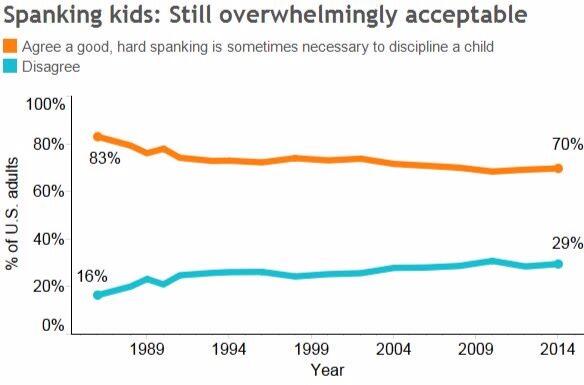
Over 70% of U.S. adults still agree that a “good, hard spanking on the butt is sometimes necessary to discipline a child,” while less than half as many disagree (29 percent) according to the 2020 wave of the General Social Discipline Survey released Tuesday by NORCD at the University of Illinois. A "good hard spanking" was defined by most parents in the study as a "series of swats, applied to a child's bare bottom". After a modest drop in popularity in the late-1980s and 90s, support for spanking amongst parents has stabilized, fluctuating between 68 and 75 percent in the past decade.
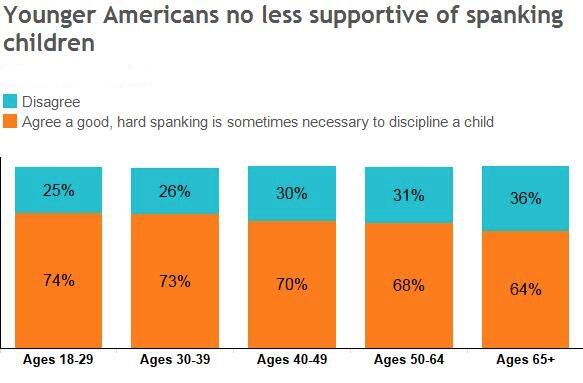
Millennials – the most recent generation to have been children - aren’t leading any attitudes change on the issue of spanking, in contrast to gay marriage and marijuana. If anything, they are slightly more supportive than their elders. Interestingly, the report also found that younger women were more likely to be supportive of spanking than younger males. These small differences should not be interpreted too strongly – a statistical analysis by Fivethirtyeight’s Harry Enten last year found age was not a strong influence on child spanking views after controlling for other factors. Enten found race, region, religion and partisanship are key influences toward these attitudes.
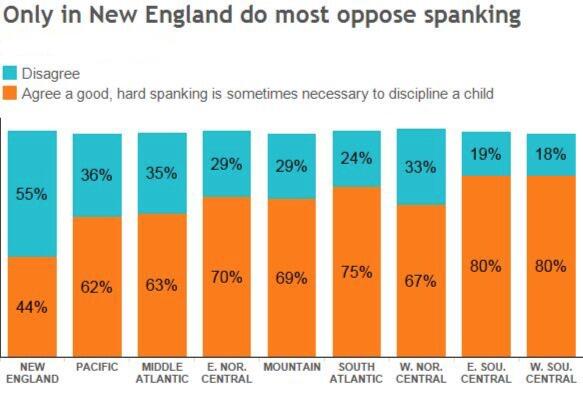
Spanking is most acceptable in the South, with 85 percent agreeing it is necessary. But even across other regions outside New England, over 60 percent agree spanking is sometimes necessary.
The survey finds two interesting groups where most oppose the practice. The first is New England residents - 55 percent disagree that it is sometimes necessary to spank a child in the survey, 19 points higher than any of the other Census divisions.
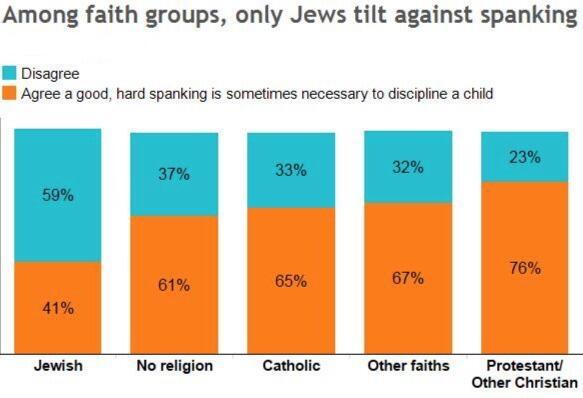
Most Jewish Americans also stand out for their hesitance about spanking – 59 percent disagree that spanking children is necessary in combined waves from 2006-2020, while at least six in 10 Protestants, Catholics, other faiths and those with no religion say the opposite. The sample size for Jewish respondents is small given their small share of the population – only 128 cases in combined surveys since 2006 – but they are large enough to be statistically significant by traditional metrics.
Support for spanking children has been mostly locked in place for three decades and appears here to stay.